Research Area
Structure and Hierarchy in Nature and Society
I love to draw systems diagrams. I do it all the time, I have many, many, spread around. Some make it into papers. They allow me, anyone, to consider complex problems, but always in manageable ways. And the symbols force you to locate your interest somewhere in the world of energy and materials, following the rules of first and second law energetics. They remind me of my linguistics ‘shoebox’, you draw many and then ‘play’ with them, looking for understanding.
The papers on this list all share the quality that they focus on structure, in some way. They all contain systems diagrams that had some meaning for me at some time. Many are now part of my ‘common sense’.
It might seem surprising, but I only recently got a good handle on Odum’s hierarchy principle. The obvious parts are easy, food chains, etc. But why hierarchy, what does it do? My answers are in my last and newest paper, listed at the bottom.
Papers
2001 "Social Structure and Ecotourism Development on Bonaire". Proceedings from the 2nd Biennial Emergy Research Conference, September 20-22, 2001, Center for Environmental Policy, Gainesville, FL
This was the first paper produced from my dissertation. It was presented at the 2nd Emergy Conference. It was refined into the Conservation Ecology paper below.
2003 “Understanding Complex Human Ecosystems: The Case of Ecotourism on Bonaire.” Conservation Ecology 7(3):10. [online] URL: http://www.consecol.org/vol7/iss3/art10.
Emergy analyses were used in a novel way to compare ‘scales’ of production processes. The result was that Bonaire had reached a new stable state after 45 years in which all three scales were once again processing similar amounts of emergy.
2004 “Systems Diagrams for Visualizing Macroeconomics.” Ecological Modeling 178(2):189-194, doi.org/10.1016/j.ecolmodel.2003.12.035
2007 “World-Systems as Complex Human Ecosystems.” In The World System and the Earth System: Global Socioenvironmental Change and Sustainability since the Neolithic. A. Hornborg and C. Crumley, eds. Pp. 56-73. Wallnut Creek, CA: Left Coast Press.
This was an amazing experience, being invited to a World-Systems conference in Lund, Sweden by Alf Hornborg. Andre Gunter Frank was there, Immanuel Wallerstein was there. Two beautiful edited volumes came out of the conference. My paper was given prestigious position in the 4th Chapter of one of the volumes, but I felt my presentation was only fair, and I have some regrets about missed opportunities. Too timid in front of those big shots, a common experience.
2007 “Emergy, Sociocultural Hierarchy, and Cultural Evolution” Proceedings from the 4th Biennial Emergy Research Conference, January 12-21, 2006, Center for Environmental Policy, Gainesville, FL
2009 “Testing Principles of Spatial Hierarchy: What Households Research Has to Say” Paper presented at the 5th Biennial emergy Research Conference, January, 2008.
From a survey of 20 households in a small coastal village on the East Coast, interviewed by my research assistant Ke-wei, I assembled a hierarchy of households. From that small piece, I produced a Hualien county diagram of households. Finally, from that, I produced a Taiwan households systems diagram, located within a world-system. I like that diagram a lot and use it to represent spatially located town and city, human hierarchies. I will refer to it in my 2025 paper. Somewhere around this time however I came to realize that I misunderstood something important about emergy analyses. Energy transformation processes produce products. For household analyses, those products should be people, not households as objects. That’s what households are for, raising and supporting people. I believe that I refused to submit this paper to the proceedings because of that.
2010 “Human Transformities in a Global Hierarchy: Emergy and Scale in the Production of People and Culture.” Ecological Modelling 221:2112-2117, https://doi.org/10.1016/j.ecolmodel.2010.05.014
2011 “The 'Locations' of People and Households within the Culture-Nature Hierarchy of Hualien County, Taiwan.” In Proceedings of the 6th Biennial Emergy Research Conference, Pp. 461-482, Gainesville, FL, 2011
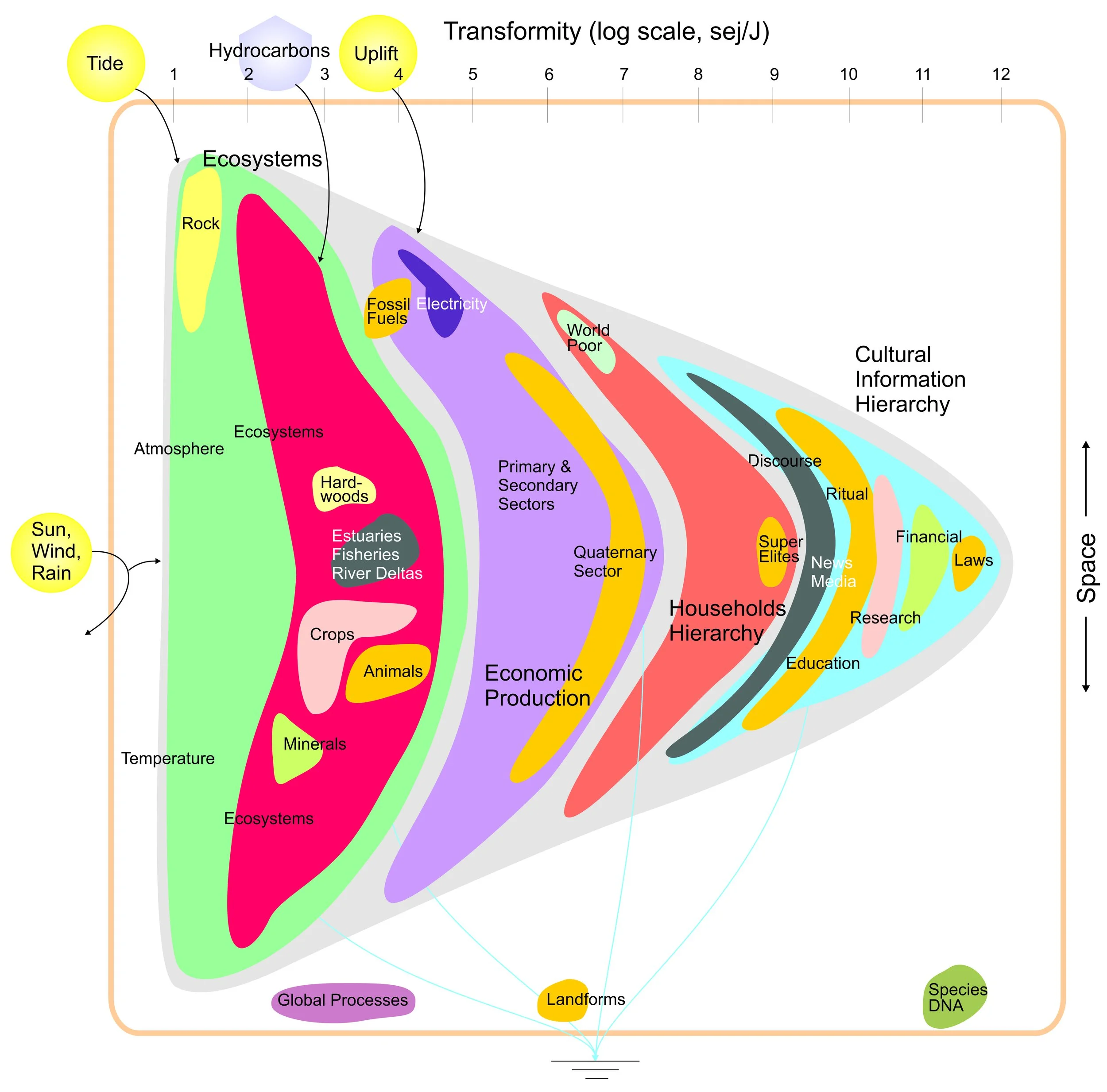
There are two good outcomes to this paper, both based on emergy analyses. The first is the production of my global culture-nature hierarchy from my database of many types of emergy analyses. They included (C) Crops, (N) Natural, Environmental, (M) Materials, Chemicals, (F) Fuels, (E) Electricity, (G) Global, (S) Ecosystems, (P) Plants, (A) Animals, (T) Trees, (H) Humans, (I) Information, (U) Urban, (L) Landform, (R) Rock, (W) Waste Treatment, (X) Atmosphere and Temperature. I use improved revisions of that diagram in many papers. Second is my emergy research focused on Hualien households and people from which I produced the households hierarchy at the center of the global diagram. I evaluated many typical inputs to households and many atypical inputs like inputs from banks, communication, government, ritual, stock markets, and others.
2013 “Energy and the Social Hierarchy of Households (and Buildings).” In Architecture and Energy. W.W. Braham and D. Willis, eds. Pp. 49-63. Routledge.
This paper came from another great conference invitation, this time to Philadelphia for the Architecture and Energy Conference at UPenn organized by Bill Braham. According to Bill, he discovered my dissertation some years ago and teaches it to his graduate students. I can attest to that because his students had some very informed questions for me about Bonaire after my talk. He is a regular at the Biennial Emergy Conference.
2014 “Culture in Cycles: Considering H.T. Odum's 'Information Cycle'.” International Journal of General Systems. 43(1):44-74. https://doi.org/10.1080/03081079.2013.852188
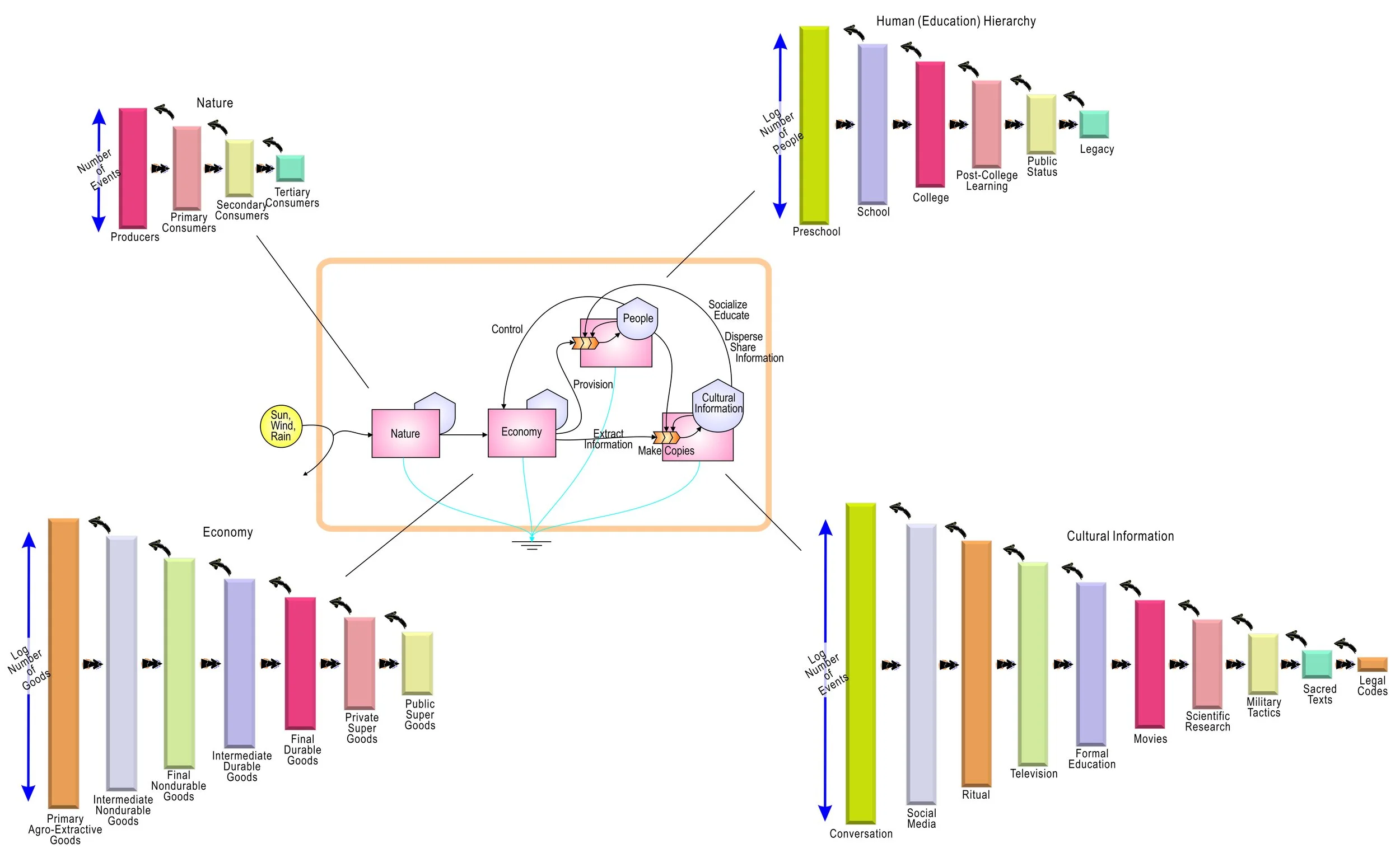
This paper was a very BIG deal for me. It included a number of important diagramming innovations, including my hierarchy of cultural information forms and my nested hierarchy of information cycles. I say more about it in the Culture in Cycles section.
2015 “Convergence and Divergence in the Production of Energy Transformation Hierarchies,” Ecological Modelling 315:4–11, https://doi.org/10.1016/j.ecolmodel.2014.11.028
My diagram in this paper of a ‘busy economy’ is more art than systems. It is an attempt to depict the dynamics of production of either manufactured objects or cultural information. The main message of the paper is that an important feature of the nested hierarchy model is that information always ‘diverges’ into the ‘world’ at the end of a cycle, from which it can be picked-up by any of the other information cycles.
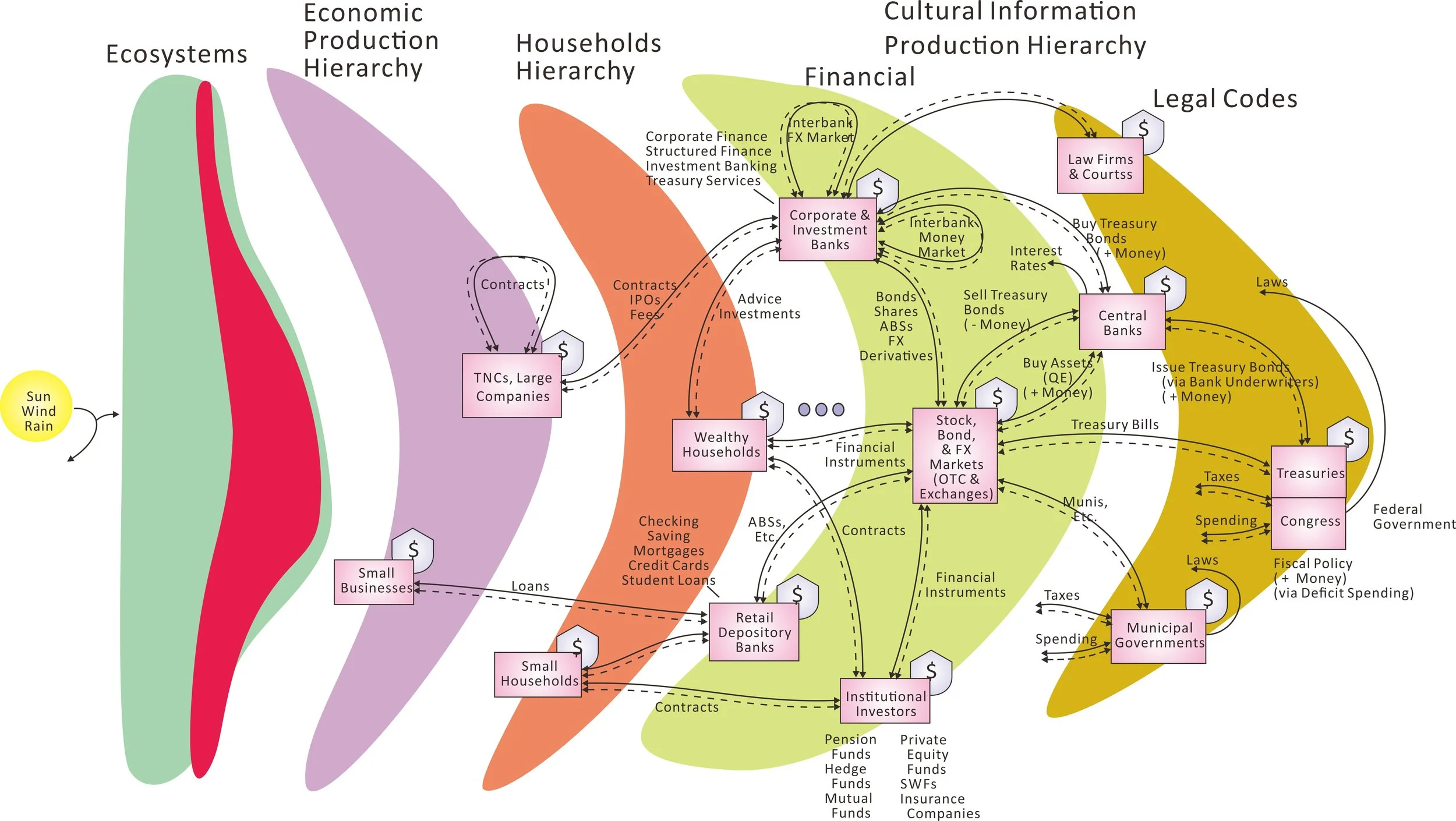
2016 “Pools of Money: ‘Information Cycles’ for the Production and Maintenance of Financial Information”. In Proceedings of the 9th Biennial Emergy Research Conference, Chapter 34, Gainesville, FL, 2016
This paper includes some very innovative diagrams of the financial industry, IMO. The focus is the production of ‘storages’ of money. In systems language, that is what the financial industry produces. Concentrations of money that can move in countercurrent to energy. See further discussion in Culture in Cycles.
2017 “Manufacturing in Cycles: Tertiary No More!”. Paper presented at the International Society for Ecological Modelling Global Conference (ISEM 2017), September 17-21, 2017, Ramada Plaza, Jeju, Korea.
This is my attempt to view manufacturing as a hierarchy of production. It is not bad for a first try, and it will go in my book also.
2023 “Building With/On Howard T. Odum’s Theory of Information.” In International Journal of General Systems. https://doi.org/10.1080/03081079.2022.2162048
This paper is another BIG paper for me. It concludes with four additional proposed hierarchies of cultural information. See the discussion in Culture in Cycles.
2025 “Howard T. Odum’s Contributions to Evolutionary Theory”, Ecological Modelling 509:111263. [online] URL: https://doi.org/10.1016/j.ecolmodel.2025.111263
And this is another BIG paper for me. Evolution has always been one of my babies, beginning with the old-style cultural evolutionists. How did Odum see evolution? See the discussion in Complex Systems.